


When the Universe was created, it consisted almost entirely of the two lightest elements, hydrogen and helium. But, look around you for a moment. We're not floating around in a gaseous haze. Where did all the heavy stuff cluttering up your bedroom come from?
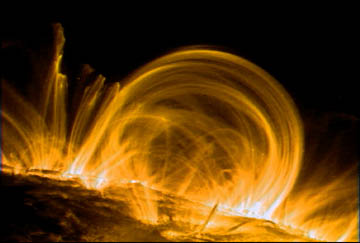
Almost all of it comes from stars, which are big balls of hydrogen and helium, bound together by gravity. Stars are so overwhelmingly, enormously large that pressure from the force of gravity fuses together the hydrogen molecules at their cores, forming helium and releasing enough energy to give you a sun burn even if you're 93 million miles away, like we are.
Once a star has fused all the hydrogen in its core into helium, the helium fuses into carbon, which in turn fuses into other heavier elements like neon and oxygen, all the way through peanut butter, ham, and bleu cheese, continuing up to iron. This takes millions or billions of years, depending on the size of the star, how enthusastic it is, and whether or not it's trying to impress young female stars in its galactic neighborhood.
This sounds pretty good, but the elements lighter than iron only make up about a quarter of the period table. Where does everything else come from? Once a star's core is converted to iron, the whole fusion thing abruptly stops working, and the star explodes, forming a supernova (Latin for, "I've had quite enough of this, thank you!") So much energy is released in a supernova that within one second, about half of the elements in the rest of the periodic table are created.
Almost all of it comes from stars, which are big balls of hydrogen and helium, bound together by gravity. Stars are so overwhelmingly, enormously large that pressure from the force of gravity fuses together the hydrogen molecules at their cores, forming helium and releasing enough energy to give you a sun burn even if you're 93 million miles away, like we are.
Once a star has fused all the hydrogen in its core into helium, the helium fuses into carbon, which in turn fuses into other heavier elements like neon and oxygen, all the way through peanut butter, ham, and bleu cheese, continuing up to iron. This takes millions or billions of years, depending on the size of the star, how enthusastic it is, and whether or not it's trying to impress young female stars in its galactic neighborhood.
This sounds pretty good, but the elements lighter than iron only make up about a quarter of the period table. Where does everything else come from? Once a star's core is converted to iron, the whole fusion thing abruptly stops working, and the star explodes, forming a supernova (Latin for, "I've had quite enough of this, thank you!") So much energy is released in a supernova that within one second, about half of the elements in the rest of the periodic table are created.

Join The Community